Motion Warning. This video includes abrupt camera movement or other effects. Stop viewing immediately if you feel discomfort.

New: AI passthrough!
This amazing Deo feature uses the power of AI to turn every VR scene into AR passthrough! Now you can take characters out of VR and have them right there with you - as if they were in the same room.
Notice: AI Passthrough is presently in beta mode, and as such, users may encounter occasional service imperfections. The feature is currently exclusive to the DeoVR app, but it will soon be accessible on both browsers and mobile devices. Your feedback is highly encouraged and appreciated.
Recommended headsets:
Meta Quest 3, and Quest Pro with stereoscopic color passthrough, Pico 4 (monoscopic color passthrough).
Compatible headsets:
Quest 2, Valve Index (monoscopic black and white passthrough).
Passthrough is not compatible yet for Oculus Link cable.
Check out our complete guide to passthrough and join in the discussion at our busy forum.
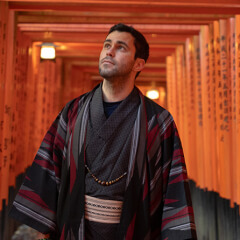
The shrine was formally founded in 711 CE by the Hata clan, an influential immigrant group from the Korean Peninsula. Inari was originally and remains primarily the kami of rice and agriculture, but merchants also worship Inari as the patron of business.[3] Each of Fushimi Inari-taisha's roughly 10,000 torii were donated by a Japanese business, and approximately 800 of these are set in a row to form the Senbon Torii, creating the impression of a tunnel.[4] The shrine is said to have ten thousand such gates in total that designate the entrance to the holy domain of kami and protect it against wicked forces.[2]
Owing to the popularity of Inari's division and re-enshrinement, this shrine is said to have as many as 32,000 sub-shrines (分社 bunsha) throughout Japan.
Credit: https://en.wikipedia.org/wiki/Fushimi_Inari-taisha