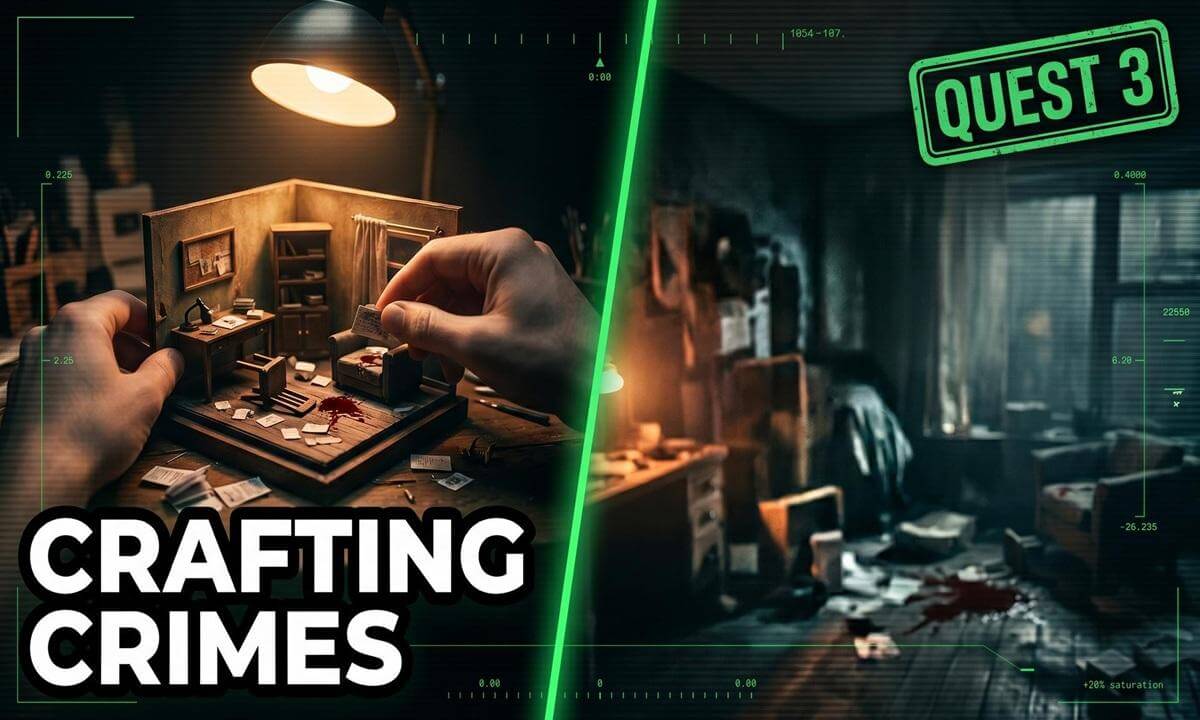
Crafting Crimes Review: Build & Explore True Crime Scenes on Meta Quest 3

#craftingcrimes #craftingcrimesmetaquest #craftingcrimesxr
A Review of Crafting Crimes — an XR experience series for Meta Quest 3 and 3S that uses hand tracking and 3D models to immerse users in interactive true crime stories.
Crafting Crimes is hosted by miniaturist Carol K. Ras. Each episode — approximately 20 minutes in length — guides users through assembling a miniaturized recreation of a real murder location on a virtual hobby workstation. A murder board tracks the individuals connected to each case. After completing the assembly, users can return and explore the completed location from an immersive, life-sized perspective using Meta Quest's passthrough capabilities.
Three episodes are currently available. Episode 1 is free. Episodes 2 and 3 are approximately $3.00 each. Episode 3 covers the 1911 theft of the Mona Lisa, with users assembling and exploring a recreation of the Louvre museum as it appeared in the early 20th century.
The experience draws a direct historical parallel to the Nutshell Studies of Unexplained Death, a series of dollhouse-scale dioramas created by forensic science pioneer Frances Glessner Lee, first donated to Harvard Medical School in 1946 for use in crime scene investigation lectures.
Footage from We Live Here and Perspectives: Paradise is included in this video.
 05:18
05:18 03:49
03:49 05:11
05:11 04:00
04:00 02:13
02:13![[ Hyperstereoscopy 3D Fireworks ] Collection of Wide Starmine Fireworks (No Music)- 02, Nagaoka Fireworks in Niigata , JAPAN](https://cdn-vr.deovr.com/images/139124/65915_vrfin-cover-app.jpg) 07:58
07:58 02:06
02:06 35:27
35:27 02:24
02:24 05:59
05:59![[ Hyperstereoscopy 3D Fireworks ] Collection of Wide Starmine Fireworks (No Music)- 01, Nagaoka Fireworks in Niigata , JAPAN](https://cdn-vr.deovr.com/images/139123/30093_vrfin-cover-app.jpg) 08:07
08:07