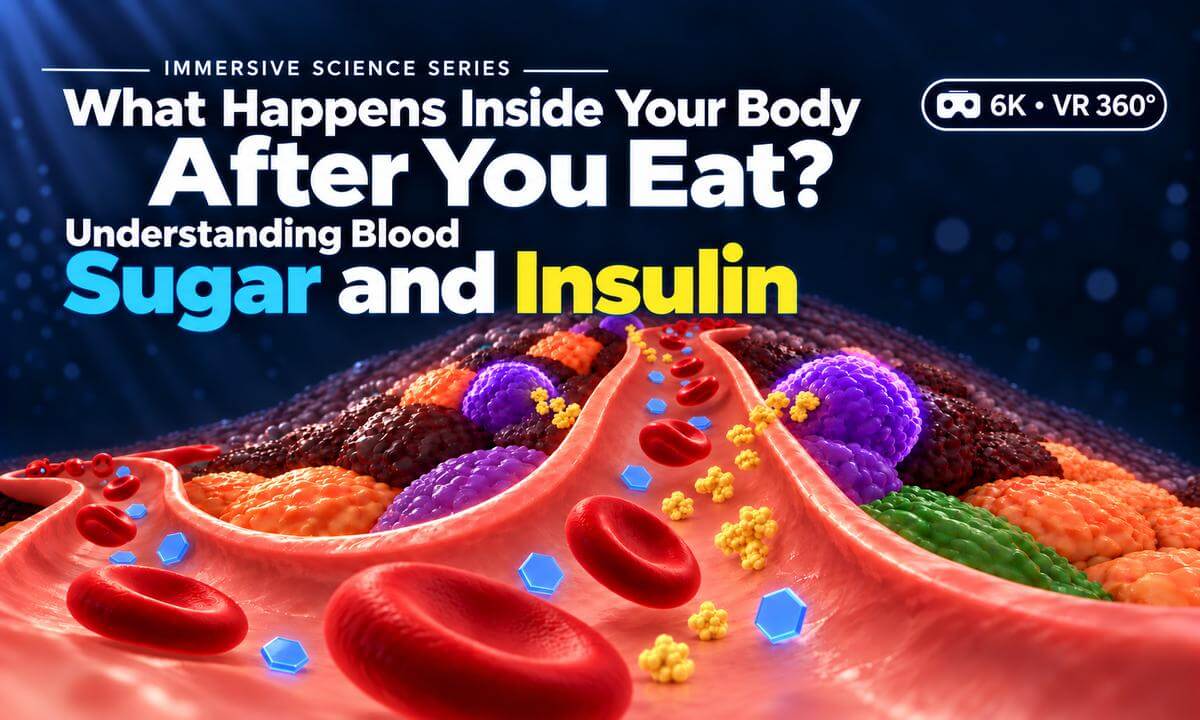
What Happens Inside Your Body After You Eat? Understanding Blood Sugar and Insulin

What happens inside your body after you eat?
Food travels down the esophagus, through the stomach, and into the small intestine.
Starch in foods like rice and bread is broken down into glucose, which is absorbed through the small intestine.
As glucose enters the bloodstream and blood sugar rises, beta cells in the pancreas detect this change and release insulin.
Insulin travels through the bloodstream to different parts of the body.
Let’s take a closer look at muscle cells, which take up large amounts of glucose.
When insulin binds to a receptor on the cell surface, it triggers a series of phosphorylation events, sending a signal into the cell.
This signal causes small vesicles carrying glucose transport proteins called GLUT4 to move toward the cell membrane.
As the vesicles fuse with the membrane, GLUT4 appears on the cell surface.
Glucose enters the cell through GLUT4.
Inside, it can be used for energy or stored as glycogen.
As muscles and other tissues take up glucose, blood sugar levels fall back toward their normal range after a meal.
 02:07
 17:25
 20:09
 07:30
 08:53
 01:35
 04:41
 02:52